Hello everybody, welcome to our recipe site, If you're looking for recipes idea to cook today, look no further! We provide you only the best Homemade Tonkotsu Ramen Broth and Noodles from Scratch recipe here. We also have wide variety of recipes to try.
Before you jump to Homemade Tonkotsu Ramen Broth and Noodles from Scratch recipe, you may want to read this short interesting healthy tips about {The Simple Ways to Be Healthy. Getting A Healthy Eater
People can either choose to consume a healthy diet or an unhealthy one. Time and access to healthy alternatives are no longer problems for a person who’s attempting to eat better and healthier foods. It is possible for people to make healthy food choices even if they only have a short period to prepare their foods. The first thing to see is that it’s often that healthy choices do not always mean a need for two-hour meals. Someone could choose healthy foods that are fast and easy to prepare at home or to pick out of a takeout place. Cities frequently provide restaurant guides within their phone books that display full-page menus indicating what a specific restaurant or drive-thru offers. A number of these food vendors now include healthy alternatives for their customary fast-food selection. At places like McDonald’s and Hardee’s, it is possible to find consumers that are worried about their carbohydrate intake. This has prompted the restaurants to provide other options in their burger choices. Hamburgers can be arranged without the bun, for example, and fruit and yogurt are contained on the menu along with fresh salads. Many restaurants offer salad options either as side orders or as complete meals. Many times, a salad of fresh vegetables with chopped ham, roast beef or poultry is much more attractive than traditional menu items. Salads are particularly attractive in the summertime since they’re lighter on the digestive tract. If house preparation of meals is preferred, the alternatives for healthy choices increase. Seeing a local grocery store or supermarket emphasizes the number of healthy choices that can be found. Fresh fruits and vegetables are more diverse than ever before due to developments in transport and preservation procedures. All types of cuisine can be prepared quickly due to the choices of fresh goods rather than frozen foods. There are numerous options among frozen foods as well. The demand for healthy frozen dishes and other foods has increased alongside demands for greater variety in frozen food offerings. Any frozen food aisle in almost any supermarket will reveal as many healthy food options and bad choices. The decision is up to the individual. Restaurants that feature foods in season cultivated by local farmers provide quite healthy and affordable choices. Some of such restaurants will create their own recipes for healthy food choices. This provides the customer with a completely fresh selection and motivates them to go to the restaurant again.
We hope you got benefit from reading it, now let’s go back to homemade tonkotsu ramen broth and noodles from scratch recipe. To cook homemade tonkotsu ramen broth and noodles from scratch you only need 19 ingredients and 25 steps. Here is how you cook that.
The ingredients needed to cook Homemade Tonkotsu Ramen Broth and Noodles from Scratch:
- Prepare Soup
- Use 5 bones Pork on the bone
- Provide 2 Japanese leek
- Prepare 2 medium Onions
- You need 1 tsp Grated ginger (tube is fine)
- Use 1 tsp Grated garlic (tube is fine)
- Get 100 grams Pork fatback
- Use 1 enough to fill a large pot Water
- Take Noodles
- Provide 500 grams All-purpose (medium) flour
- Provide 1 -5 1/2 grams Powdered kansui (alkaline minerals)
- Get 200 ml Water
- Take 1 for dusting Katakuriko
- Use Char siu (Chinese-style roasted pork)
- Prepare 500 grams Thinly sliced pork belly
- Get 50 ml Soy sauce
- Get 50 ml Mirin
- Get 1 tbsp Sugar
- Provide 500 ml Water
Instructions to make Homemade Tonkotsu Ramen Broth and Noodles from Scratch:
- I got these pork bones at the supermarket (they were being sold for about 15-30 yen per 100 g in my neighborhood). I think about 5 bones come out to 3 kg.
- Wash off the blood under running water. Place the bones in a large pot of cold water. Bring the pot to a boil (at this point, the bones will be giving off a very strong odor, but don't worry).
- A lot of scum will come to the surface. Scoop it out diligently (I know this part is a bit off-putting, but stick with it. It'll turn out okay).
- Strain in a colander and remove the remaining blood from the bones with a scrubbing brush.
- Use a saw to make a slice in middle of the bones, and a hammer to break them in half. (It's easier if you make an incision before snapping them).
- Look at all the bone marrow inside the bones. We'll be melting it out by simmering these bones over a long period of time.
- Now start to add the other ingredients for the soup. Diligently remove the scum that rises to the top. Keep the heat at medium and maintain a gentle boil.
- Once the scum has been removed, simmer the broth for another 6 hours. Add more water if it boils off.
- Next we'll be preparing the noodles. Measure out the ingredients and mix the flour and powdered kansui together. Add the water. It'll feel like a very small amount of water, but don't worry.
- Mix the ingredients until the dough starts to clump together in the bowl.
- The dough is a pretty tough one, so be careful not to hurt your wrists. Try mixing it with the weight of your body.
- Move the dough to a working surface and knead. Don't worry too much about cracks or inconsistencies yet. Just knead for about 10 minutes.
- Round up into a ball, wrap with plastic cling wrap, and let sit in the refrigerator (for at least 30 minutes. Then check if the dough has settled).
- Prepare the char siu in the meantime. Brown the meat in a frying pan, and simmer for 2 hours in a pot with the combined seasoning ingredients. Let cool in the pot.
- Once the dough has become moist, roll out to a thickness of 5 mm. Use a pasta machine to even it out to your desired thickness.
- If you don't have a pasta machine, just use a rolling pin to stretch out the dough (but remember that the dough will thicken up about 1.3 times, so include that in your calculations).
- You can manage with just a little bit of dusting flour (katakuriko or bread flour) since the dough isn't that sticky.
- Apparently a wooden box is best for storing Chinese noodles, but if you don't have one on hand, just transfer them to a tray lined with parchment paper. Insert tray in a plastic bag and keep cool in the refrigerator.
- About two hours after simmering the broth, it'll start to get white and cloudy. I wouldn't taste testing it just yet, since it'll still be somewhat smelly.
- Here's what the broth should look like after 6 hours of simmering. The marrow has melted out of the bones, which have emptied out. The soup now looks quite rich and smells like it should (just like what you get a ramen joint).
- The char siu should have become a caramel brown. Take care not to break it apart when you're slicing the meat, since it'll be quite soft at this point.
- Enjoy the leftovers with a cold beer!
- Now that you have everything prepared, get ready to make your ramen. Boil each serving of noodles separately and adjust the times carefully by watching over them. If you'd like your noodles rippled, squeeze the noodles once and fluff them out again before boiling.
- Warm up the bowl you'll be using for the ramen. Add the simmering sauce you used for the char siu and season with some salt (starting on the lighter side so the taste is easier to adjust) and pour in the pork broth you prepared earlier.
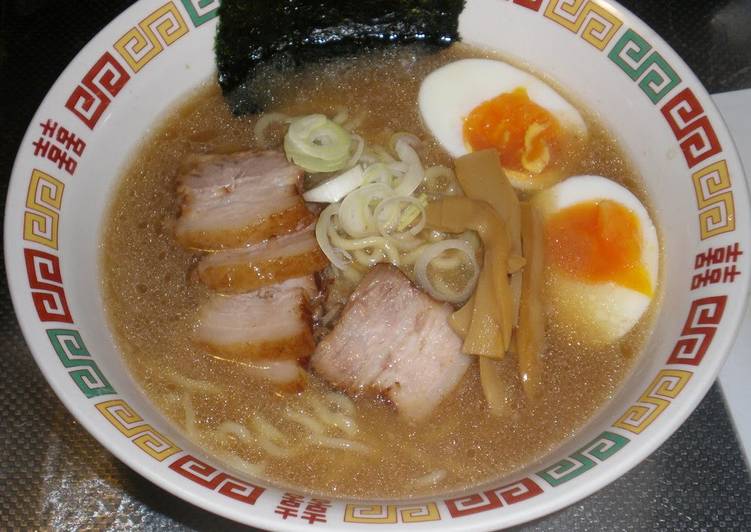
- The boiling time for the noodles should be about 1:30-2 minutes, but this is something you can change according to your preferences. Once you add your noodles to the soup and garnish with your desired toppings, your rich and creamy tonkotsu ramen is complete.
If you find this Homemade Tonkotsu Ramen Broth and Noodles from Scratch recipe helpful please share it to your friends or family, thank you and good luck.